

Why Most Facilities Are Miscalculating the Cost of Downtime
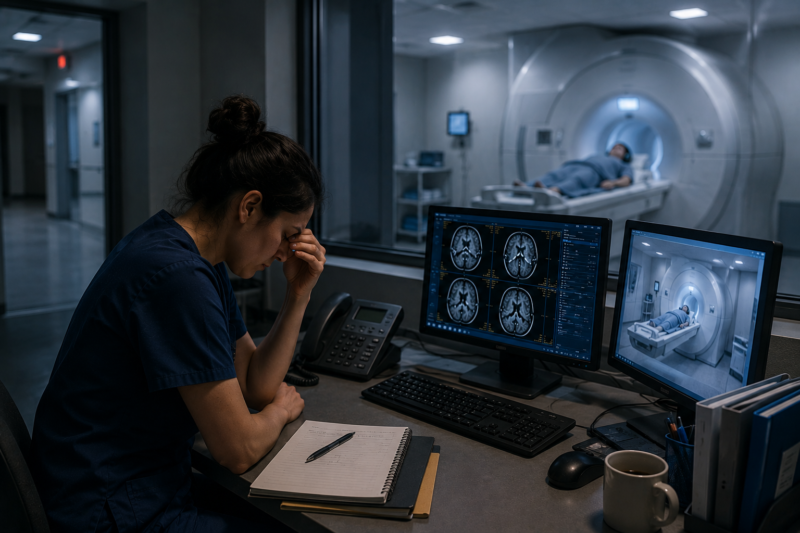
When MRI downtime occurs, the instinct in most imaging centers is to reach for the same set of numbers: canceled scans, missed reimbursements, and total hours of scanner unavailability. These figures are meaningful, and they deserve attention — but they describe only the most immediate and visible layer of what a downtime event actually costs a facility.
The broader operational consequences of a halted MRI system extend well beyond what appears in a revenue report. They ripple through scheduling infrastructure, strain clinical and administrative staff, affect the patient experience in ways that have lasting implications for trust and retention, and send a signal to referring physicians that reverberates through professional relationships over time. Facilities that limit their downtime assessment to the most obvious financial losses are working with an incomplete picture — and that gap in understanding tends to produce an underestimation of what full recovery actually requires.
The full scope of downtime impact includes:
- Scheduling disruption across current and future appointment blocks
- Increased staffing burden and associated overtime costs
- Erosion of patient trust and satisfaction
- Strain on referring physician confidence and referral patterns
- Administrative workload generated by rescheduling, re-screening, and reauthorization
- Declining departmental morale in an already demanding work environment
- Compressed future throughput as the schedule absorbs displaced appointments
The damage that doesn’t appear on the incident report tends to accumulate in ways that catch facilities off guard — quietly, across departments, and over a timeline that extends well past the moment the scanner comes back online.
The Scheduling Impact Begins Immediately
MRI appointment schedules operate with very little slack. Patient volumes are high, booking windows are tight, and the sequencing of appointments is carefully managed to maximize throughput within the constraints of scan time and staffing capacity. When a scanner goes down, that carefully constructed schedule doesn’t pause — it fractures, and the effects propagate through the rest of the day and frequently into the days that follow.
Every patient displaced by an unplanned outage requires individual attention: direct outreach to communicate the disruption, rescheduling coordination that accounts for both patient availability and remaining scanner capacity, re-verification of safety screening documentation, and in many cases, renewal of insurance authorizations that may have lapsed. None of these tasks are quick, and none of them can be handled in bulk. They land on staff who are simultaneously managing the rest of the day’s workflow, and the cumulative administrative burden is significant.
The patient-side impact of these disruptions carries its own weight. Many patients arrive for MRI appointments having made meaningful personal arrangements — time arranged away from work, transportation organized, childcare secured. A cancellation without adequate notice doesn’t simply move an appointment; it disrupts a day that was already structured around attending it. When that experience is handled poorly, or recurs with any regularity, the trust that facilities invest in building through quality care and strong communication erodes more quickly than most administrators appreciate.
MRI equipment failures are also more visible to patients than most other operational disruptions. The scanner is the defining feature of the department’s function, and when it is unavailable, patients notice and remember — in a way they typically would not with a scheduling software issue or an administrative delay.
Staff Burnout Builds Quietly During Downtime Events
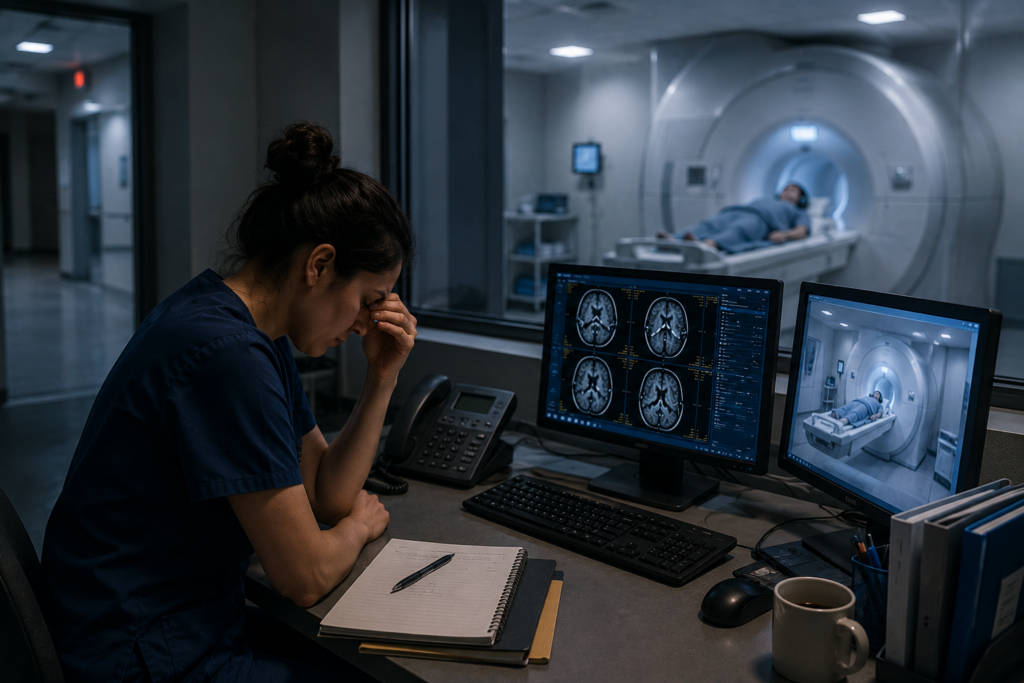
The operational burden of an unplanned MRI outage does not distribute evenly across a facility. It concentrates on the technologists and scheduling coordinators who must manage its immediate consequences in real time — fielding patient calls, restructuring the day’s appointments under time pressure, communicating with referring providers, and coordinating access for service engineering, all while attempting to maintain the normal rhythm of the department’s remaining functions.
The demands that downtime places on clinical and administrative teams include:
- Managing patient frustration and recalibrating expectations in the moment
- Rescheduling displaced appointments under significant time pressure
- Extending clinical hours where possible to recover lost throughput
- Absorbing future scheduling capacity to accommodate displaced patients
- Maintaining ongoing communication with referring providers throughout the outage
- Coordinating service engineering access and monitoring recovery timelines
- Developing and executing manual operational workarounds across administrative systems
In departments that are already operating near capacity — which describes the majority of high-volume imaging environments — these demands don’t simply add to existing workloads. They intensify them substantially, and they do so without warning. Staff who encounter this pattern repeatedly, rather than as an isolated incident, are at elevated risk of burnout. The downstream cost of losing experienced MRI technologists to exhaustion and turnover — in recruitment, training, and the institutional knowledge that takes years to develop — is considerable and rarely captured in downtime cost analyses.
Referring Physicians Are Paying Attention
The professional relationships that sustain an imaging center’s referral volume are built on a foundational expectation: that the facility will deliver reliable scheduling access and consistent diagnostic turnaround. Referring physicians plan patient care around those expectations, and when operational reliability is repeatedly in question, the relationship becomes harder to depend on — regardless of how strong the imaging quality itself may be.
The operational inconsistencies that most directly affect referring physician confidence include:
- Reduced patient access to diagnostic services during outage periods
- Scheduling availability that referring practices cannot plan around
- Report turnaround times that extend when schedule compression follows an outage
- Patient throughput variability that creates downstream uncertainty for clinical planning
Referral pattern shifts rarely announce themselves. They develop gradually, driven not by a single significant failure but by the accumulation of smaller, recurring disruptions that make a facility feel unreliable as an operational partner. A referring physician who has rerouted patients around availability problems enough times begins to adjust their default referral behavior — not because of any formal decision, but because predictability matters in the day-to-day management of patient care, and facilities that cannot consistently provide it become progressively less central to how referring practices operate.
Preventative Maintenance Deserves a Broader Frame
Preventative maintenance discussions in imaging departments tend to be organized around compliance — ensuring that service intervals are documented and that accreditation requirements are met. These are legitimate concerns, but they represent a narrow view of what a well-designed maintenance program actually provides operationally.
A structured, proactive approach to equipment servicing is among the most reliable tools available to imaging facilities for reducing the frequency and severity of unplanned outages. The operational benefits extend well beyond regulatory compliance:
- Significantly reduced risk of catastrophic system failures that result in extended downtime
- Lower frequency of unanticipated service interruptions and the scheduling disruption they cause
- Reduced dependence on emergency parts sourcing, which commonly extends recovery timelines
- The ability to approach equipment servicing strategically, with planned interventions rather than reactive emergency responses
- A lower risk of one equipment failure cascading into broader scheduling and operational disruption
Facilities that maintain consistent, well-documented maintenance schedules operate more predictably, and that predictability benefits every stakeholder in the imaging environment — patients depending on timely diagnostic access, technologists working to deliver consistent care, administrators managing operational performance, and referring physicians planning treatment around expected turnaround times. Treated as an operational investment rather than a compliance obligation, preventative maintenance is one of the most cost-effective mechanisms available for protecting service continuity.
Downtime Recovery Decisions Are Rarely Purely Technical
One of the less-discussed dynamics of major MRI outages is how quickly the recovery process shifts from a technical conversation to a financial one. Decisions about whether to repair or replace, which service provider to engage, whether an interim fix is sufficient or a more comprehensive solution is warranted, and how to weigh component lead times against operational urgency all carry significant cost implications — and all of them directly influence how long the facility remains functionally compromised.
The financial considerations that most commonly shape recovery timelines include:
- Cost-benefit analysis of repair versus full unit replacement
- Evaluation of OEM service capabilities versus independent providers, including response time commitments
- Assessment of interim solutions against the risk of recurring failure and a second extended outage
- Component availability and realistic lead times, factored against the ongoing cost of continued downtime
- Whether loaner unit access is feasible and what procuring one would require logistically
What these decisions consistently reveal is that the option with the lowest upfront cost is not always the option with the lowest total cost. When the full financial picture is considered — continued revenue loss, staff overtime, patient attrition, and the reputational cost of an extended operational disruption — a more comprehensive service solution will frequently represent the stronger long-term investment. Facilities that approach these decisions through a narrow cost lens risk extending the financial impact of the original failure well beyond what a more complete resolution would have required.
Operational Resilience Is What Separates High-Performing Imaging Departments
The imaging centers that manage downtime most effectively are not necessarily the ones that experience it least — they are the ones that have built the operational infrastructure to respond to it with speed, clarity, and minimal patient impact. Resilience in this context is not an abstract quality; it is a measurable function of the structures, relationships, and preparation a facility has in place before an equipment failure occurs.
Operational resilience in a high-performing imaging department typically includes:
- Clearly documented escalation pathways that activate immediately when equipment fails
- Pre-established service agreements with engineering partners that include defined response windows
- Realistic expectations for response and recovery timelines, negotiated with vendors in advance
- A consistent and well-maintained preventative maintenance schedule
- Proactive vendor communication that surfaces performance concerns before they become outages
- Contingency planning that addresses extended downtime scenarios beyond the first 24 hours
- Confirmed access to loaner equipment when extended unavailability is a realistic possibility
Facilities that invest in this infrastructure before a crisis experience the same equipment failures as those that don’t — but they handle them differently. The response is faster, better coordinated, and less disruptive to patients and staff because the operational framework for managing the situation already exists and has been tested.
Conclusion
MRI downtime is rarely a purely technical problem, and facilities that treat it as one tend to underestimate both its true cost and the investment required to manage it effectively. An equipment failure becomes a staffing problem, a scheduling problem, a patient experience problem, a referral relationship problem, and a financial problem — often simultaneously, and often in ways that outlast the outage itself.
The imaging departments best positioned to navigate downtime are those that understand it in its full operational context. They recognize that the measure of an organization’s response capability is not how it performs when everything is functioning, but how it holds up when something goes wrong — and they build their systems, relationships, and maintenance programs around that reality long before a specific failure demands it.