

The Staffing Problem Most Departments Are Living With
Recruiting and retaining qualified MRI technologists has become one of the more persistent operational challenges in imaging — and for most departments, it has been that way for several years now. The contributing factors are well known to anyone managing an imaging operation: a limited pipeline of trained technologists, ongoing attrition from burnout, steadily rising patient volume, heavier documentation requirements, and pressure to keep scan throughput moving without a proportionate increase in staff. The result is that many MRI departments are operating closer to their functional limits than their policies or staffing plans formally acknowledge.
What gets discussed less often is what that operational reality means for safety. MRI safety guidance is generally written with adequately staffed departments in mind. When the actual conditions diverge from those assumptions — and in a significant number of facilities, they do — the safety infrastructure those guidelines describe becomes harder to maintain in practice.
Safety Protocols Built for Conditions That May Not Exist
Most MRI safety frameworks rest on a set of working assumptions: that trained personnel are nearby if something goes wrong, that support staff are accessible, that a technologist can call for help quickly, that workflow disruptions are manageable, and that the person running the scanner is not already carrying more than they can reasonably handle. Under those conditions, the protocols work as designed.
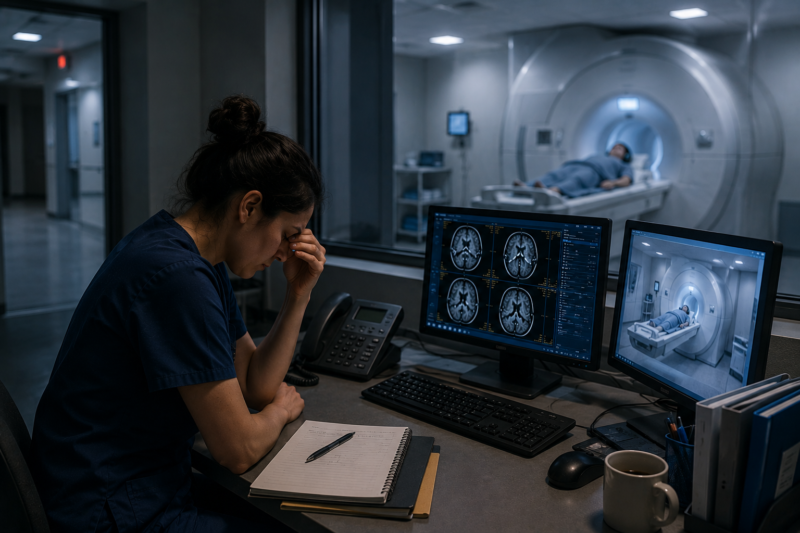
The gap between that description and daily operations in many imaging departments is the issue. A technologist on a given shift may be managing multiple scanners simultaneously, handling an anxious or medically complex patient, troubleshooting a scheduling problem, keeping up with documentation, covering for an absent colleague, and coordinating with remote staff — all at the same time. Even in well-staffed departments, competing demands are a constant feature of the job. When staffing is thin, the same demands land on fewer people, and the margin for managing them without something slipping narrows accordingly.
The risk is not that technologists become careless under those conditions. It is that the system they are working within becomes less forgiving. Small delays compound. Communication shortcuts accumulate. The double-checks that catch errors before they become incidents get harder to sustain when there is no time to stop.
MRI Rooms Create Conditions That Amplify Staffing Strain
The physical and operational characteristics of an MRI suite make staffing shortfalls more consequential than they would be in most other clinical environments. MRI rooms are typically isolated from the general flow of hospital activity — acoustically insulated, access-controlled, and subject to strict ferromagnetic restrictions that govern what can enter the space and how quickly. That design is necessary for the technology to function, but it also means that the built-in redundancies that exist elsewhere in a hospital — nearby colleagues, accessible equipment, open sightlines, quick physical access — cannot be assumed in an MRI setting.
Emergency response in other clinical areas relies heavily on speed: hear a problem, enter the room, bring equipment, provide assistance, escalate if needed. In an MRI environment, several of those steps carry additional complexity. Entry requires ferromagnetic screening. Standard emergency equipment may not be safe to bring into Zone IV. Responders without MRI-specific training may hesitate when they encounter restrictions they were not expecting. In a time-sensitive emergency, that hesitation has consequences.
When staffing is already stretched, the weight of those additional demands falls on whoever is present. In many cases, that is one person.
The Single-Technologist Reality
One of the less visible staffing issues in MRI operations is how frequently technologists work without consistent on-site support. This is not always the result of poor planning. It reflects the practical constraints that many departments operate under — technologist shortages, scheduling realities, budget limitations, and growing exam volumes that have outpaced hiring.
The consequence is that a single technologist is often the only qualified person in or immediately adjacent to Zone IV during a scan. Under routine conditions, that is manageable. But MRI scanning is not always routine. Patient instability, acute anxiety or panic, falls, mobility complications, patient entrapment, aggressive behavior, medical emergencies, and quench-related events are all scenarios that have occurred in MRI environments and that require immediate, coordinated response. When one person is responsible for both managing the patient and initiating that response, the margin for an effective outcome is narrower than it should be.
Communication efficiency in this context is not a secondary concern — it is central to how quickly a situation gets resolved. MRI shielding can affect wireless device performance depending on room construction and device placement. The zone structure that makes the environment safe also creates physical boundaries that information has to cross. In a time-sensitive event, delays in reaching additional help compound quickly. These are not hypothetical vulnerabilities. They are operational features of MRI environments that staffing plans need to account for explicitly.
Throughput Pressure and How It Changes Behavior
Throughput pressure is a constant in most imaging departments, and it operates quietly on clinical behavior in ways that are worth naming directly. The organizational incentives are straightforward: reduce delays, minimize cancellations, keep the schedule moving, and avoid extended scanner downtime. Those goals are legitimate. The problem is that when they are applied to a department already running lean, the behavioral effects are predictable.
Under sustained pressure, technologists — like all clinical professionals — tend to move faster, multitask more, rely more heavily on memory rather than documented checks, and take communication shortcuts that save time in the moment. Mental fatigue accumulates across a long shift. The likelihood of a verification step being compressed or skipped increases not because of carelessness but because the conditions make thoroughness harder to sustain. A significant share of MRI adverse events can be traced not to knowledge gaps but to workflow conditions that created the opportunity for a known risk to be overlooked.
That is a systems problem, not a personnel problem. Addressing it requires looking at what the workflow is actually asking of people, not just at whether protocols are written correctly.
Remote Scanning Introduces New Operational Questions
Remote MRI operations have expanded considerably in recent years, driven by the real advantages they offer: greater scheduling flexibility, broader coverage across facilities and shifts, and the ability to extend specialist oversight to settings that could not otherwise support it. Those benefits are genuine.
What remote workflows do not change is the physical reality inside the scan room. The patient is local. The magnetic environment is local. If something goes wrong — a patient deteriorates, a safety concern emerges, a situation requires physical intervention — the response has to come from someone present. Remote oversight can support clinical decision-making, but it cannot substitute for a person in or adjacent to the room.
As remote scanning becomes more common, the operational questions that surround it become more important to answer precisely: Who is physically present when something needs an immediate response? How is the room being monitored, and by whom? What does escalation look like when the technologist overseeing the scan is not on-site? What happens if communication between the remote operator and the local environment is disrupted? These are not arguments against remote scanning as a model. They are the planning questions that determine whether a remote workflow is safe under real conditions rather than ideal ones.
The Risk That Prevention-Focused Safety Frameworks Miss
MRI safety conversations have historically concentrated on preventing known hazards — projectile incidents, burns from RF exposure, implant interactions, unauthorized zone access. That focus is appropriate. Those risks are serious and well-documented, and the protocols designed to prevent them represent decades of hard-won institutional knowledge.
What receives less systematic attention is the response side of the equation: what happens after an adverse event begins. MRI emergencies are frequently time-sensitive. A patient who is in distress inside the bore, a ferromagnetic object that has entered the field, a medical event that requires rapid escalation — in each of these cases, the speed and coordination of the response matters as much as any preventive measure. When staffing is thin, when communication systems are not designed for the shielded environment they operate in, and when escalation pathways are vague or untested, response times extend in ways that prevention-focused safety frameworks do not capture.
Facilities that have started thinking about safety in terms of both prevention and operational resilience are asking a different set of questions: How quickly can a technologist reach help? What does escalation look like in practice, not just on paper? Is the emergency response plan written for the MRI environment specifically, or adapted from general hospital protocols that do not account for zone restrictions? Has that plan been tested?
Where Technology Can Reduce Operational Vulnerability
Technology cannot replace adequate staffing, and framing it as a staffing solution creates a false sense of security. What well-designed operational tools can do is reduce the specific points of friction and vulnerability that understaffed departments are most exposed to.
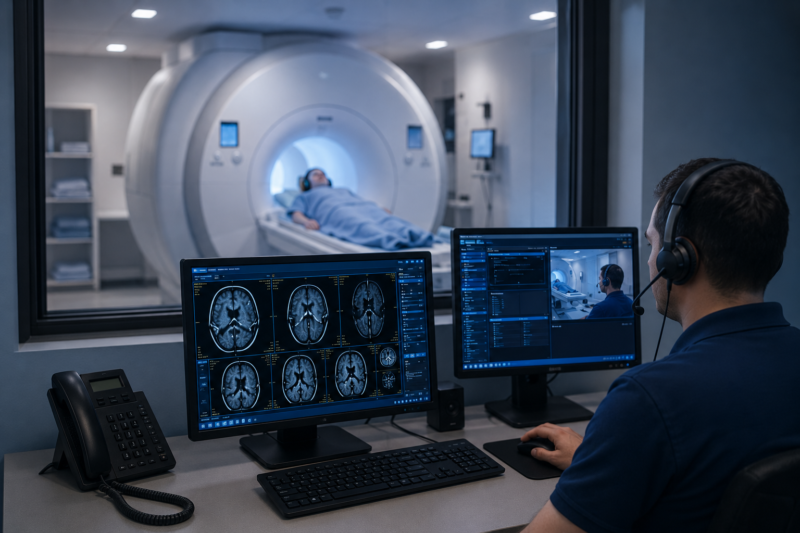
Improved room visibility gives technologists better situational awareness without requiring physical presence in the scan room at all times. Hands-free communication systems make it faster and easier to call for help without interrupting patient care. Clear digital escalation pathways reduce the cognitive load of figuring out who to contact and how under pressure. Passive monitoring tools provide a layer of awareness that does not require active attention to be useful. The common thread is that the most effective tools in this context are ones that work in the background — reducing burden rather than adding steps, and activating quickly when they are needed rather than creating friction in the routine workflow.
The Questions Worth Asking
The imaging departments that tend to manage staffing-related safety risks most effectively are not necessarily the ones with the most resources. They are the ones that have been willing to look honestly at the gap between how their department is documented to operate and how it actually functions on a busy shift. That assessment leads to better questions:
- Are current safety protocols realistic given actual staffing levels, or do they describe an idealized version of the department?
- How quickly can a technologist in the scan room reach additional help?
- What does the department’s emergency response look like when the technologist is effectively working alone?
- Are communication systems reliable within the specific shielded environment of the suite?
- Does the escalation pathway work under pressure, and has it been tested?
- Are remote workflows supported by clear, defined local response plans?
These questions are uncomfortable to sit with, particularly when the honest answers reveal gaps that are not easy to fix quickly. But they are the questions that distinguish departments managing safety proactively from those that are managing it reactively — after an event has already made the gap visible.
Conclusion
MRI safety has always required more than a list of prohibited items and a set of zone restrictions. It requires the people, the communication infrastructure, the workflows, and the response planning to function reliably when something goes wrong — not just when conditions are favorable. Staffing shortages do not eliminate any of those requirements. They make each of them harder to meet.
The departments best positioned for the years ahead are the ones that have stopped treating staffing as an HR problem that sits separately from safety and started recognizing it as a variable that shapes how safely their environment can operate on any given day. That shift in perspective does not solve the underlying workforce challenge. But it changes what decisions get made, and it changes what gets prioritized when resources are limited and tradeoffs are unavoidable.