
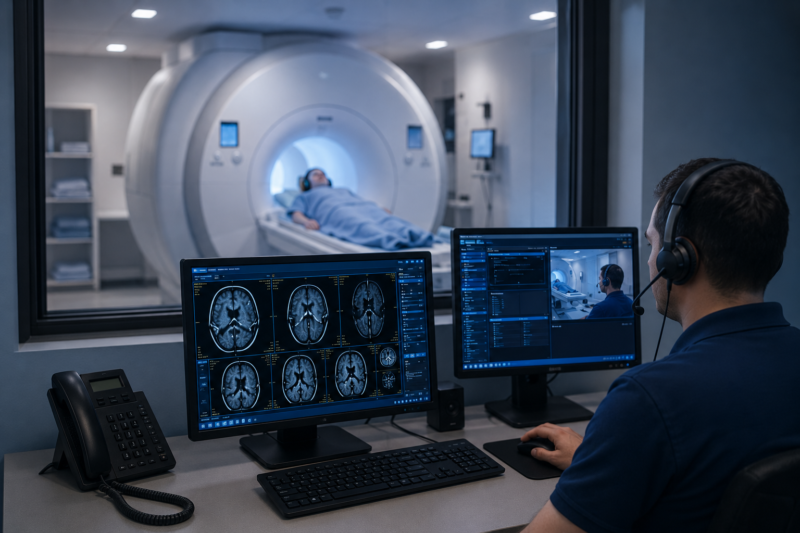
A recent incident reported by Radiology Business has raised serious concerns about patient safety inside MRI suites.
A patient in a hospital in Wuhan was left inside an MRI scanner for nearly six hours—not due to equipment failure, but due to a breakdown in human processes.
What Actually Happened?
- The scan was marked “completed” in the system while the patient was still inside
- Staff shift handover failed to verify the MRI room
- The patient remained immobilized, afraid to move
- He was only discovered hours later by cleaning staff
This wasn’t a technical fault.
It was a visibility failure.
The Real Problem: “Out of Sight, Out of Mind”
MRI rooms are:
- Isolated
- Often soundproof
- Physically separated from control areas
Once the door closes, there is no continuous visual confirmation unless someone actively checks.
In this case, the system said the scan was complete—but no one confirmed if the patient had actually left.
That gap between system status vs. real-world visibility is where risk lives.
Why This Is More Common Than We Admit
Even in well-managed facilities:
- Staff are multitasking
- Shift changes happen frequently
- Assumptions replace verification
- Emergency situations rely on someone noticing
And when no one is watching, small oversights can escalate into critical incidents.
How a Wide-Angle MRI Room Camera Changes This
Imagine if the MRI room had a continuous wide-angle visual feed:
- Staff could instantly see if a patient is still inside
- No reliance on memory or handover notes
- Real-time visibility during and after every scan
- A simple glance could prevent hours of risk
This is not about replacing staff—it’s about supporting them with certainty.
Adding an MRI Room Alert System: From Passive to Proactive Safety
Now combine that camera with an intelligent Room Alert system:
1. Presence Awareness
Detect if someone remains inside the MRI room after scan completion
2. Time-Based Alerts
Trigger alerts if a patient stays inside longer than expected
3. Remote Monitoring
Allow supervisors or safety teams to verify room status instantly
4. Emergency Communication Support
Ensure patients are never truly “alone” in a silent room
The Key Lesson: Never Rely on One Layer of Safety
This incident proves one thing clearly:
Digital systems alone are not enough.
Even when protocols are followed, human error + lack of visibility = real risk.
Building a Safer MRI Environment
A safer MRI suite should include:
- Process (ACR protocols, checklists)
- People (trained staff)
- Technology (real-time visibility + alerts)
Because safety should not depend on:
- Memory
- Assumptions
- Or luck
Final Thought
The patient in this case was fortunate to be found.
But the question every facility should ask is:
If this happened in our MRI room today… how quickly would we know?